
90% of the world doesn’t believe a few American giants should rule AI, tell them what to do, and extract 10’s of billions from them. England, France, Brazil, India and Africa believe they must have a role. Worldwide cries for “digital sovereignty” are becoming louder every week.
Xi’s message, “Working together to build a fair and reasonable global AI governance system,” appeals to many. 29 nations, 37% of the world’s population, have already signed on to the World Artificial Intelligence Cooperation Organization (WAICO). United Nations Secretary-General António Guterres stood with them.
In contrast, the U.S. insists on making the rules. “It is a national security imperative for the United States to achieve and maintain unquestioned and unchallenged global technological dominance.”
If you were Indian, French, Brazilian or Mexican, which will be more appealing?
Xi Jinping’s keynote speech at the opening ceremony of the 2026 World Artificial Intelligence Conference and the High-level Meeting on Global Governance of Artificial Intelligence (Full Text)
2026-07-17 12:56
Working together to build a fair and reasonable global AI governance system
—Keynote speech at the opening ceremony of the 2026 World Artificial Intelligence Conference and the High-level Meeting on Global Governance of Artificial Intelligence
(July 17, 2026, Shanghai)
President Xi Jinping of the People’s Republic of China
Distinguished colleagues, honored guests,
ladies and gentlemen, friends:
Seventy years ago, a group of young scholars first proposed the concept of artificial intelligence at the Dartmouth Conference in New Hampshire, USA. Over the past seventy years, AI scientists and researchers around the world have continuously explored the unknown, forged ahead through setbacks, and achieved breakthroughs through perseverance. Seventy years later, facing a new wave of booming AI development, our gathering on the banks of the Huangpu River to discuss promoting the global development of AI towards a positive, benevolent, and beneficial direction for humanity is of great significance. On behalf of the Chinese government and the Chinese people, I extend a warm welcome to all of you.
Looking back at history, the invention of the steam engine ushered in industrial civilization, the widespread adoption of electricity illuminated modern society, and the birth of the internet connected the entire world. Each technological revolution has profoundly reshaped human production and lifestyles, propelling significant leaps in economic and social development.
Currently, the world is undergoing rapid changes, with a new round of technological revolution and industrial transformation accelerating. Global artificial intelligence technology innovation is entering an unprecedented period of activity. Intelligent technologies, characterized by the Internet of Everything, human-machine collaboration, cross-sector integration, and co-creation and sharing, are releasing enormous energy, presenting both immense opportunities and governance challenges. Humanity must confront the questions of our time: When machines begin to think, how should we interact with them? When algorithms participate in decision-making, how can security be guaranteed? When technology challenges ethics, how can governance keep pace? As the gap widens, how can inclusive benefits be achieved? These questions require deep reflection and collaborative answers from the international community.
China believes that all countries should uphold the principles of people-centeredness and positive values, making artificial intelligence a significant driving force for promoting common prosperity and safeguarding common security, and working together to build a just and equitable global AI governance system. Here, I would like to offer four points.
First, we must uphold openness and win-win cooperation to drive innovative development. Artificial intelligence is a new engine for global economic growth and an accelerator for the transformation of old and new growth drivers, moving from the “digital world” to the “physical world.” We must seize this rare historical opportunity, encourage open source and open collaboration, and comprehensively promote artificial intelligence technology innovation, industrial development, and application scenarios. We must also coordinate the transformation and upgrading of traditional industries, the cultivation and expansion of emerging industries, and the forward-looking planning of future industries, so that artificial intelligence can empower all sectors.
Second, we must strengthen risk awareness and ensure safety and controllability. Artificial intelligence should be a trustworthy tool for humanity. We must attach great importance to the various inherent and derivative risks arising from artificial intelligence, promote the construction of a legal and regulatory, technical monitoring, risk warning, and emergency response system, solidify the safety bottom line, prevent abuse and misuse, and ensure that artificial intelligence always remains under human control. At the same time, we should jointly oppose the practice of generalizing the concept of national security in the field of artificial intelligence and placing our own national security above the security of other countries.
Third, we should encourage inclusiveness and promote mutual learning among civilizations. The development and application of artificial intelligence should not erode or damage the diversity of world civilizations and the uniqueness of national cultures. We should shape the values of artificial intelligence with the common values of all humankind, make good use of artificial intelligence technology to enhance understanding and tolerance among different civilizations, promote exchanges and mutual learning among different civilizations, and carefully cultivate a garden of civilizations where each civilization is beautiful in its own way and together they complement each other.
Fourth, we must advocate for concerted efforts and improve global governance. Artificial intelligence is a shared intellectual achievement and a valuable asset of all humankind. We must practice genuine multilateralism, effectively leverage the important role of the United Nations, strengthen the alignment and coordination of AI development strategies, governance rules, and technical standards, and establish a broadly consensus-based global governance framework as soon as possible, so that this cutting-edge technology can better benefit human society. We must also broadly promote international cooperation to help countries in the Global South strengthen their capacity building, bridge the digital divide, promote sustainable development, and avoid creating new historical injustices in the field of artificial intelligence.
Ladies and gentlemen, friends!
This year marks the start of China’s 15th Five-Year Plan. The 15th Five-Year Plan outlines the blueprint for China’s economic and social development over the next five years and also provides a list of opportunities for the international community. In recent years, China has actively embraced the development of artificial intelligence, adhering to a combination of an effective market and a capable government, strengthening AI technological innovation, actively promoting the “AI+” initiative, and cultivating a healthy ecosystem where various entities coexist and prosper. The core industries of the intelligent economy have already exceeded one trillion yuan in scale. Various smart terminals have entered millions of households, truly benefiting people’s livelihoods, and “Made in China 2025” has become another shining example of Chinese-style modernization.
At the same time, China has always adhered to the principle of giving equal importance to development and security, grasped the development trends and laws of artificial intelligence, and continuously improved relevant laws, regulations, policies, application norms, and ethical guidelines to ensure that artificial intelligence is safe, reliable, and controllable, so that this thoroughbred horse of artificial intelligence can run both fast and steadily.
As a responsible major country, China has always been committed to being a provider of international public goods in the field of artificial intelligence. Since I proposed the Global Artificial Intelligence Governance Initiative, China has successively promoted the UN General Assembly to adopt a resolution on international cooperation in artificial intelligence capacity building by consensus, released the Inclusive Plan for Artificial Intelligence Capacity Building and the International Cooperation Initiative on “Artificial Intelligence+”, and proposed the establishment of a World Artificial Intelligence Cooperation Organization, continuously contributing Chinese solutions.
As the Chinese saying goes, a single string cannot produce a sound, and a single tree cannot make a forest. The development of artificial intelligence should not be a solo performance by any one country, but rather a symphony of global cooperation. With the joint efforts of all parties, the World Artificial Intelligence Cooperation Organization was established in Shanghai, and a concept conceived a year ago has already translated into tangible results. This is a significant initiative by China to respond to the call of the Global South and to unite the international community in actively promoting the development and governance of artificial intelligence, and it will become a major milestone in the history of artificial intelligence development.
To further support the development of global artificial intelligence and promote global AI capacity building, I announce that over the next five years, China will provide 5,000 training opportunities in AI-related specialties for developing countries; establish international AI application cooperation centers for ASEAN, the Arab League, the African Union, CELAC, the SCO, and BRICS countries; and promote the application of the “Mazu” intelligent meteorological early warning solution in 30 countries, safeguarding the lights of every household and protecting peace and tranquility across the world.
Ladies and gentlemen, friends!
“The wise adapt to the times, and the knowledgeable adjust to circumstances.” The more rapidly artificial intelligence technology develops, the more accurately it must be anchored in its positive, benevolent, and beneficial direction for humanity; the more precisely the scale of regulation and governance must be grasped; and the more promptly and effectively measures must be improved to prevent it from spiraling out of control. We must always guide the development of artificial intelligence with human wisdom and international consensus, so that it truly becomes a powerful positive force for enhancing the well-being of all humanity and promoting the progress of human civilization.
China is willing to work with all parties to seize and address the opportunities and challenges of artificial intelligence development with a more open attitude, more pragmatic actions, and a longer-term vision, and jointly create a better future for human society!
Thank you everyone!
Xi offers four observations on AI development, governance
Xinhua | July 17, 2026
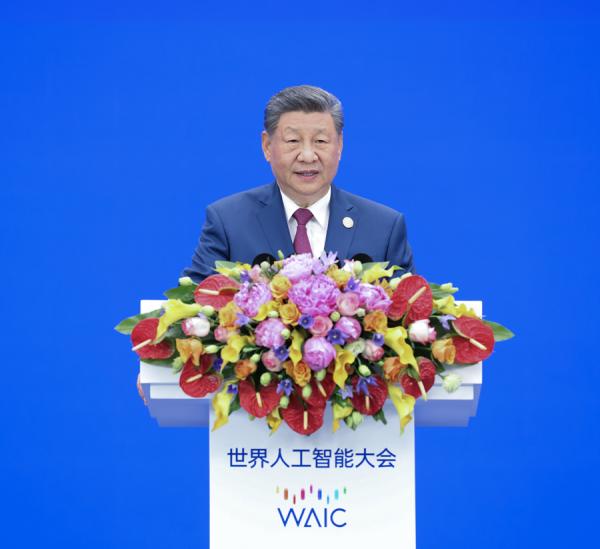
Chinese President Xi Jinping delivers a keynote speech at the opening ceremony of the 2026 World AI Conference and High-Level Meeting on Global AI Governance in Shanghai, east China, July 17, 2026. (Xinhua/Huang Jingwen)
Chinese President Xi Jinping on Friday presented four observations on artificial intelligence (AI) development and governance while addressing the opening ceremony of the 2026 World AI Conference and High-Level Meeting on Global AI Governance.
First, adhering to the principle of openness and win-win cooperation while boosting innovation-driven development. Xi highlighted the importance of encouraging open-source, openness, collaboration and sharing to facilitate technological innovation, industrial development and scenario-based application of AI.
Second, strengthening risk awareness and ensuring that AI is secure and controllable. Stressing the need to ensure that AI is always under human control, Xi urged all sides to jointly oppose overstretching the national security concept in the field of AI or placing one country’s security over that of others.
Third, encouraging inclusiveness and promoting mutual learning among civilizations. AI development and its application should not erode or undermine the diversity of world civilizations or the uniqueness of cultures of different countries, according to Xi.
Fourth, advocating solidarity and improving global governance. The important role of the United Nations should be recognized, Xi said, calling for further alignment and coordination on AI development strategies, governance rules and technical standards.
“We must carry out extensive international cooperation and help Global South countries with capacity building to bridge the AI and digital divides, promote sustainable development and prevent creating new historical injustice in AI,” he said.
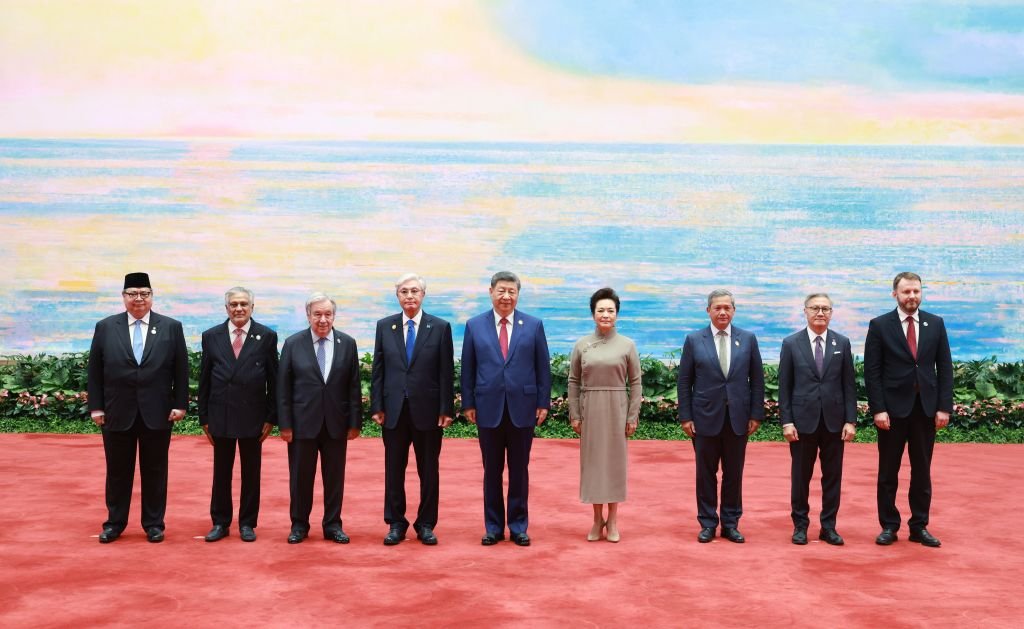
Mohammad Ishaq Dar – Deputy Prime Minister (and Foreign Minister) of Pakistan. [1]
Denis Manturov – First Deputy Prime Minister of the Russian Federation (attending as head of the Russian tech and governance delegation). [1]
António Guterres – Secretary-General of the United Nations. [1]
Kassym-Jomart Tokayev – President of Kazakhstan. [1, 2]
Xi Jinping – President of the People’s Republic of China. [1, 2]
Peng Liyuan – First Lady of China. [1, 2]
Hun Manet – Prime Minister of Cambodia. [1, 2]
Anutin Charnvirakul – Prime Minister of Thailand. [1, 2]
Alikhan Smailov – Chairman of the Executive Committee of the World Artificial Intelligence Cooperation Organisation (WAICO)